Sub Bass
Manual · version 0.1
An 808-style mono bass on MIDI: one oscillator, a slide between overlapping notes, a decay envelope, drive and a lowpass. It plays one note at a time. The last note wins, and releasing it goes back to a note you are still holding.
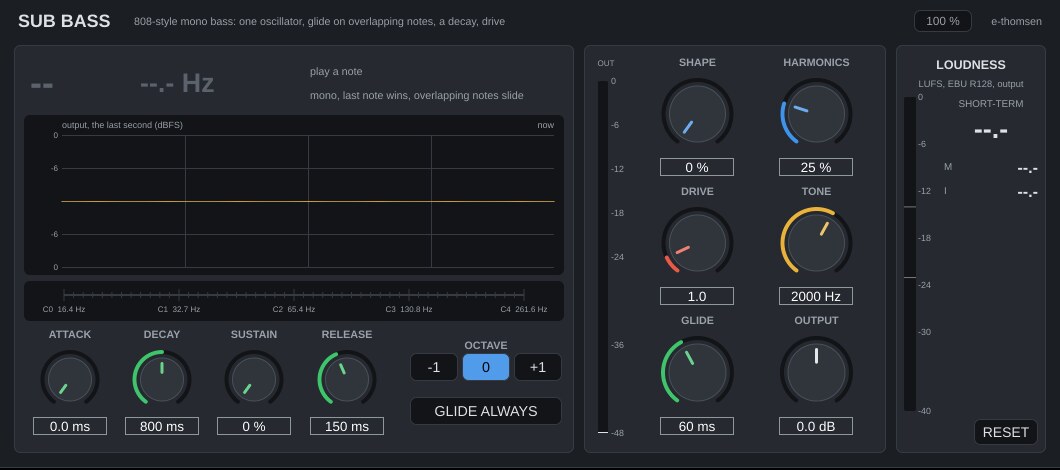
Where it goes
On a software instrument track, for pop, hip-hop and EDM low end. It is an instrument, so it has no bypass. Velocity and the sustain pedal are not used; the pitch wheel bends two semitones each way.
Note names are scientific: A1 is 55 Hz. Logic's piano roll names its keys an octave lower and calls the same key A0.
Controls
| Control | What it does |
|---|---|
| Shape | 0 to 100 %, default 0. Sine at 0, triangle at 100. The triangle adds odd harmonics (the third at -19 dB) for a slightly firmer bottom. |
| Harmonics | 0 to 100 %, default 25. Adds the second and third harmonic as clean sines, at -6 dB and -8 dB against the fundamental at 100 %. This is what makes a 40 Hz note audible on small speakers. The peak stays where the plain sine is (-6 dBFS at 0 dB output), so turning it up does not push the level into the next plugin. |
| Drive | 0 to 10, default 1. Tanh saturation, loudness-matched on a full-level note. 0 is clean. Drive also holds the tail up, as on a driven 808: with the 800 ms decay the note is 8.7 dB down at 800 ms clean, 6.3 dB at drive 1 and 2.1 dB at drive 5. Lower Decay when you drive hard. |
| Tone | 200 Hz to 8 kHz, default 2 kHz. A 12 dB per octave lowpass after the drive. Lower it to keep the drive's buzz out of the vocal range. |
| Glide | 0 to 500 ms, default 60. The time a slide takes to arrive. The slide is exponential in pitch, so it moves fast at first and settles; at the glide time it is within 1 % of the new note. |
| GLIDE ALWAYS | Off by default. On: every note slides from the previous one, not only overlapping notes. |
| Attack | 0 to 50 ms, default 0. A linear rise. 0 does not click, since every new note starts at zero phase. |
| Decay | 50 to 5000 ms, default 800. Exponential fall to the sustain level; at the decay time the note is 8.7 dB down. |
| Sustain | 0 to 100 %, default 0. Where the decay settles while the key is held. An 808 is decay-only, so 0. |
| Release | 10 to 2000 ms, default 150. After the note-off the note fades on an exponential curve that reaches silence at exactly the release time. |
| OCTAVE | -1, 0 or +1, default 0. Moves everything an octave. |
| Output | -12 to +12 dB, default 0. |
The display
The readout shows the note, its frequency and, during a slide, the pitch it is passing through (note and cents, in blue). The scope shows the last second of the output, so the decay shape is visible. The lane below it runs from C0 to C4: the dot is the pitch now, the ring the target. The loudness panel measures the output.
Working with it
- Load it on a software instrument track and play the bass line.
- Set Decay to the length of the notes you want. With Sustain at 0 a held note dies away on its own, so the line breathes with the kick.
- Bring Harmonics up until the bass reads on small speakers. Add Drive for weight and pull Tone down until the buzz sits under the vocal.
- For slides, overlap the next note with the previous one in the piano roll and set Glide to the length you want. Use GLIDE ALWAYS when every note should slide.
- Check the level against the kick with the loudness panel.
Under the hood
One oscillator, with the sine blended into a triangle and the two harmonic sines on the same phase; the sum is scaled so the peak stays at the sine's. A note that arrives when no key is held resets the phase and starts the envelope, and a note still sounding is faded out under it over 4 ms, so a retrigger does not click. An overlapping note keeps the phase and the envelope running and only moves the pitch.
Drive adds 2.4 dB of gain into the tanh curve per step, +24 dB at 10, with a level match built for a full-level sine. A short gate at the end of the release takes the filter's tail away too, so the note is silent at the release time. Notes and pitch bend are applied at their sample position inside the host block.