Headroom Check
Manual · version 0.2
An analyser for the mix bus. It answers one question: will this mix reach the target loudness cleanly, and if not, why. It does not touch the sound unless PREVIEW is on.
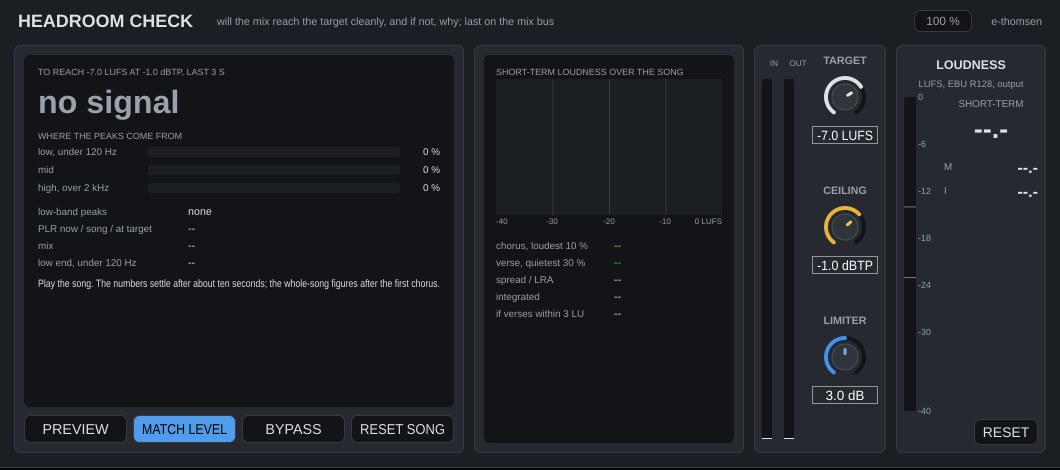
Where it goes
Last insert on the mix bus, while you mix. The audio comes out 1.5 ms late (72 samples at 48 kHz), the lookahead of the modelled limiter. That latency is reported to Logic, so the bus stays in time with everything else. When the mix is ready, Loud on the master does what Headroom Check models.
Controls
| Control | What it does |
|---|---|
| Target | -14 to -4 LUFS, default -7. The loudness the master is meant to reach. |
| Ceiling | -3 to 0 dBTP, default -1. The true-peak limit of the master. |
| Limiter | 0 to 6 dB, default 3. How much of the needed reduction a lookahead limiter takes. The rest is modelled as a clipper in front of it. |
| PREVIEW | Hear the modelled chain: gain to the target, clipper, and a 1.5 ms lookahead limiter at the ceiling. |
| MATCH LEVEL | Plays the preview at the input's loudness, so you compare tone at equal level. |
| BYPASS | The input, delayed by the same 1.5 ms, with the preview off. |
| RESET SONG | Restarts the song statistics. |
PREVIEW and MATCH LEVEL fade over 25 ms when switched, so you can flip them while the song plays without a click.
The display
| Control | What it does |
|---|---|
| Input | Loudness (EBU R128), true peak, PLR now (3 s) and over the song, and the PLR the target implies: ceiling minus target, 6 dB for -7 LUFS at -1 dBTP. |
| Needed | How far the peaks exceed the ceiling once the mix is raised to the target, split into what the limiter can take and what is left for a clipper. Green under 4 dB, amber to 7, red above. |
| Where the peaks come from | At each moment the peaks go over the ceiling, the excess is credited to the band that dominates it: low (under 120 Hz), mid or high (over 2 kHz). For the low band it also gives the frequency of the peaks, for example "around 55 Hz". |
| Low end | Left against right correlation, and side against mid, below 120 Hz. |
| Over the song | A histogram of short-term loudness, chorus (loudest 10 %), verse (quietest 30 %), spread and LRA, and the integrated loudness you would get if everything under chorus minus 3 LU were lifted to there. The difference is what the arrangement costs. |
| Advice | A sentence that says what to do about it. |
The colours follow two rules of thumb. A master chain of clipper and limiter does 4 to 6 dB cleanly; more than that has to come from the mix. Verses 6 LU under the chorus cost about 1.5 LU of integrated loudness, and 8 LU cost about 2.5.
Working with it
- Insert it last on the mix bus and set Target and Ceiling for the release.
- Press RESET SONG and play the song through once.
- Read Needed and its colour. If it is amber or red, read where the peaks come from and the advice under it.
- Fix it in the mix: clip transients at the channel or bus, duck the bass under the kick, mono the low end, high-pass what is not kick or bass.
- Press PREVIEW with MATCH LEVEL on to hear roughly what the master will do to the mix at the same loudness.
Under the hood
The true peak is read with 4x interpolation. The plain path and the preview path are both delayed by the lookahead, so they are aligned sample for sample and switching between them is a short crossfade between two versions of the same signal. The modelled limiter's gain is the minimum of the required gain over the lookahead window; the frequency of low-band peaks comes from the zero crossings of the low band at the moments the peaks go over.