Kick Synth
Manual · version 0.1
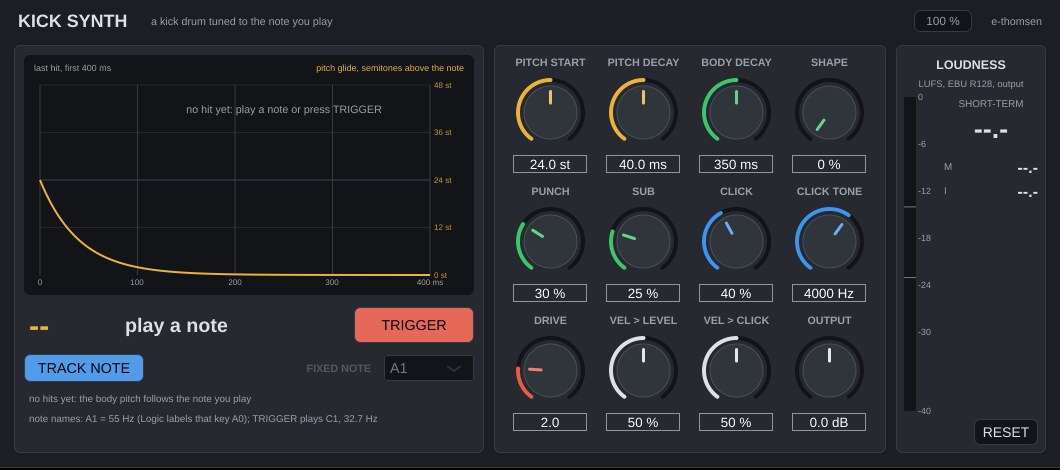
A kick drum synthesizer with few controls. The body is tuned to the note you play, so the kick sits in the key of the song: play the root in the low octave and the kick's fundamental is that note. It is monophonic: every new note restarts the kick.
Where it goes
On a software instrument track. MIDI in, stereo out, no audio input. It is an instrument, so it has no bypass. Note-offs are ignored: every hit plays out its full decay. A new note fades the ringing one out over 1 ms, so a fast retrigger does not click.
Note names are scientific: A1 is 55 Hz, C1 is 32.7 Hz. Logic names its keys an octave lower (Logic's C3 is middle C), so the key Logic calls A0 plays the 55 Hz A1 here.
Controls
| Control | What it does |
|---|---|
| TRACK NOTE | On by default: the body pitch is the note played. Off: every note plays the FIXED NOTE and the keys only trigger. |
| FIXED NOTE | C0 to C3, default A1 (55 Hz). Used when TRACK NOTE is off. |
| Pitch start | 0 to 48 semitones, default 24. How far above the note the hit starts. 24 is two octaves, four times the frequency: the boom of a classic electronic kick. 0 is a plain tone with no drop. |
| Pitch decay | 5 to 200 ms, default 40. How fast the pitch falls to the note. It is a time constant: after 40 ms about a third of the drop is left. Short is a tight thud, long is a laser-like sweep. |
| Body decay | 50 to 2000 ms, default 350. How long the kick rings. Also a time constant: at 350 ms the body is 8.7 dB down, at three times that 26 dB down. |
| Shape | 0 to 100 %, default 0. Sine to triangle. More harmonics, so the kick reads on small speakers; at 100 % the third harmonic is 19 dB under the fundamental. |
| Punch | 0 to 100 %, default 30. A short level overshoot at the start, up to +6 dB, fading out over 10 ms. The tail is left alone. |
| Sub | 0 to 100 %, default 25. A second sine one octave below the body, with the same pitch glide and the same decay. At 100 % it is as loud as the body. |
| Click | 0 to 100 %, default 40. The beater: filtered noise plus a short 1.5 kHz blip, 5 to 15 ms long. |
| Click tone | 1 to 8 kHz, default 4 kHz. Lowpass on the click noise. Darker clicks are longer (15 ms at 1 kHz, 5 ms at 8 kHz), and the click keeps about the same level at any tone. |
| Drive | 0 to 10, default 2. Saturation on the sum, with auto-gain: from 0 to 10 the level of the first 300 ms changes by at most 1.5 dB. High settings flatten the peaks and make the tail sustain. |
| Vel > level | 0 to 100 %, default 50. How much velocity sets the level. At 0 every hit is the same. At 100 % velocity 64 is 6 dB under 127; at 50 % it is 2.5 dB under. |
| Vel > click | 0 to 100 %, default 50. The same for the click alone, so soft hits can be rounder. |
| Output | -12 to +12 dB, default 0. |
| TRIGGER | Plays a C1 hit (32.7 Hz) at velocity 127 from the window, for shaping the sound with no MIDI running. |
The display
The first 400 ms of the last hit as a waveform, with the pitch glide drawn over it in amber (semitones above the note, scale on the right). Under it, the body pitch in large text: the last note played when tracking, the fixed note when not. The loudness panel measures the output. At the defaults a velocity-127 hit peaks at -4.8 dBFS.
Working with it
- Put it on an instrument track with TRACK NOTE on and program the kick on the root note of the song, in the octave around 40 to 60 Hz: E1 to B1 here, E0 to B0 in Logic. For a song in F, play F1, which Logic calls F0.
- Start from the defaults. Set Body decay against the tempo and the bass: 150 to 250 ms for a busy bass line, 600 ms and up for an 808-style kick that is the bass.
- Set the character with Pitch start and Pitch decay, and how the kick cuts through on small speakers and phones with Click and Click tone.
- Add Sub for weight on big systems, and Drive for loudness and harmonics when the kick has to survive a loud master.
- If a section's bass moves to the fifth, the kick can follow on the same track. For a kick that never changes pitch, turn TRACK NOTE off and pick the fixed note once.
Under the hood
The body is one oscillator, sine blended into a triangle of the same phase. Its pitch starts Pitch start semitones above the note and falls exponentially in semitones, so the glide lands on the note. The amplitude decays exponentially, with a short raised-cosine overshoot for Punch. The sub runs at exactly half the body frequency at every sample. The click is white noise through a lowpass at the click tone and a 300 Hz highpass, plus a 1.5 kHz sine. Drive is a tanh curve with a make-up gain that keeps the level steady.
Every note starts on its own sample, also with several notes in one host block. Limits: one voice, so overlapping hits (a flam) cut each other after 1 ms. Pitch bend is ignored. The triangle is not band-limited; at kick frequencies the aliasing is far below the signal, but a tracked note above C4 with Shape at 100 % and a high pitch start will alias a little at the start of the hit.