Loud
Manual · version 0.3
The last plugin on the master. Set the target loudness and the true-peak ceiling, press AUTO, and the mix lands there. The meters show what it cost.
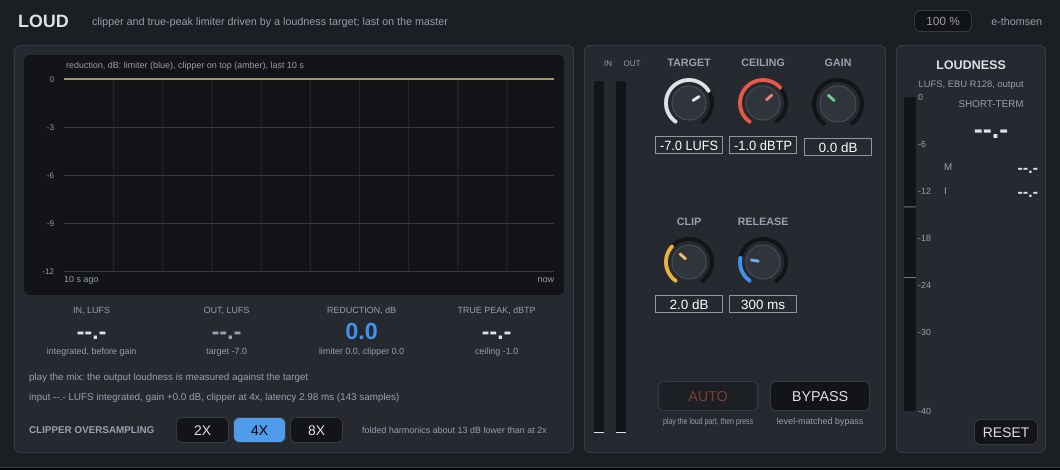
Where it goes
Last on the master, after everything else. An input gain brings the mix up, a soft clipper takes the tops of the transients, a true-peak lookahead limiter takes the rest, and a hard clip 0.1 dB over the ceiling guards the result. The latency is 143 samples (2.98 ms at 48 kHz) at every oversampling setting, reported to Logic and never changed, also during a bounce. Headroom Check on the mix bus tells you beforehand how hard Loud will have to work.
Controls
| Control | What it does |
|---|---|
| Target | -14 to -4 LUFS, default -7. Where the output should land. Only AUTO and the output readout use it. |
| Ceiling | -3 to 0 dBTP, default -1. The output true peak never goes above this. |
| Gain | -12 to +24 dB, default 0. The input gain before the clipper. AUTO writes it. |
| Clip | 0 to 6 dB, default 2. The clipper flattens everything above the ceiling plus this many dB, with a 3 dB knee; the limiter handles the band between. At 0 the clipper does almost all the work (dense, crunchy); at 6 the limiter does (cleaner, more pumping on sustained peaks). At 2 the clipper gets the drum tops and the limiter the rest. |
| Release | 100 to 1000 ms, default 300. The slow release. A fast 50 ms release handles the transients on its own; the slow one follows the programme and keeps the gain from pumping between hits. |
| Oversampling | 2x, 4x or 8x, default 4x. The rate the clipper runs at. 4x is the setting to master at. Try 8x when Clip is low, the material is bright and there is a grit that is not in the mix; 2x costs the least CPU. Changing it while playing crossfades over 20 ms. Bounces always render the clipper at 8x, and the line under the status says "render: 8x" while they do. |
| AUTO | A button, not a parameter. Sets Gain so the output lands on the target. The label under it shows what it will set. The suggestion is based on the input's loudness since the last RESET, so play the loudest part first. |
| BYPASS | Level-matched. The plugin makes the mix louder, so a plain bypass would only tell you that louder sounds better. When engaged, the input plays at the loudness the output had just before (capped at 20 dB, 25 ms fade), and the label shows the match applied. |
| RESET | In the loudness panel. Restarts the loudness measurement, input and output, and with it the AUTO suggestion. |
The display
The trace is the limiter reduction (blue) with the clipper reduction stacked on top (amber), in dB, over the last 10 seconds. Under it: input integrated loudness, output short-term loudness against the target (green within 1 LU, red above, amber below), the reduction right now, and the output true peak held for 1.5 s, red if it ever passes the ceiling by more than 0.1 dB. The status line says how far the output is from the target and how many LU the clipper and the limiter are costing. The line under it gives the input loudness, the gain, the oversampling and the latency.
Working with it
- Insert it last on the master. Set Target (-7 LUFS for pop and EDM, -9 to -8 LUFS for country and atmospheric music) and Ceiling (-1 dBTP for streaming).
- Play the chorus and press AUTO.
- Read the status line. If the clipper and the limiter cost more than 3 LU, the mix is asking too much; go back to Headroom Check and the mix.
- Otherwise listen with BYPASS on and off at the same loudness. What you hear is only what the clipper and the limiter did.
- If the drums have lost their edge, lower Clip. If the bass is pumping, raise Release. If it sounds dull and soft, raise Clip.
Under the hood
AUTO is more than target minus input loudness, because the clipper and the limiter cost loudness, a couple of LU at -7 LUFS. A second copy of the chain runs on the input at the gain AUTO would set, and the suggestion adds what that copy lost. It is within 0.5 dB after 6 seconds of playback and settles by 10. The copy runs only when it is needed: for 20 seconds after the plugin starts, after RESET or a change of settings, and while the window is open.
The clipper is oversampled because bending the waveform makes harmonics that would otherwise fold back into the audible band. On a 9 kHz sine pushed 9 dB into the clipper, the folded component at 3 kHz is 34.5 dB under the tone at 2x, 47.8 dB at 4x and 78.6 dB at 8x. The limiter's peak detector reads between the samples (true peak), so it holds down the peak a converter will actually produce, with a linear attack over the 1.5 ms lookahead and no overshoot. Stereo is linked. A lossy encoder after the master adds its own overshoot, which is why the default ceiling is -1 dBTP.