Kick Tune
Manual · version 0.4
Retunes the body of a kick drum and leaves the click alone. Zero latency, phase coherent, mono and stereo.
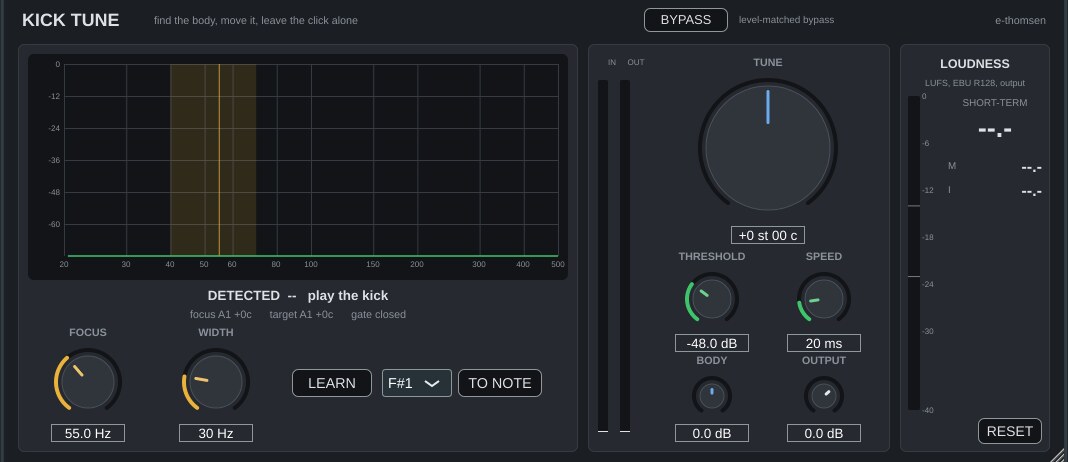
The idea
A kick is a broadband click followed by a decaying near-sinusoid with a short pitch glide. The tuning you hear is the decay. The plugin captures the tonal component in a band around the fundamental, moves it by the number of hertz that corresponds to the requested cents, and puts it back. Everything outside the band, including the click, passes through untouched by construction: with Tune at 0 and Body at 0 the output is bit-identical to the input.
The shift is in hertz, not in ratio. On a kick, whose overtones are weak, that is inaudible. On a snare or a tom with strong overtones it would detune them against each other, which is why this is a kick tuner and not a drum tuner.
Controls
| Control | What it does |
|---|---|
| Focus | 30 to 400 Hz, the centre of the captured band. LEARN sets it to the detected pitch. |
| Width | 10 to 100 Hz, the capture bandwidth. Wider catches more of the glide and the overtones; narrower is cleaner. Start at 30. |
| Tune | ±1200 cents, shown as semitones and cents. The target frequency is drawn as a dotted line on the spectrum. |
| Note selector and TO NOTE | Pick a note from C1 to B3 and press TO NOTE: Focus is set to the detected pitch and Tune to the cents that bring it to the note. |
| Threshold and Speed | The gate. Below the threshold the signal passes unprocessed, so bleed on a drum bus is left alone. Speed is the attack; release is four times longer. The readout shows the gate state. |
| Body | ±12 dB, the level of the shifted body against the original. Lower it if a downward shift builds up boom. |
| Output | -24 to +12 dB. |
| BYPASS | Level-matched: captures the loudness difference when engaged and plays the raw input at that level. |
The detector
Each hit above the threshold is captured and its pitch glide is tracked through the hit with short autocorrelation windows every 8 ms. If the glide settles, staying within 3 percent of its final value for at least 40 ms while the body is still within 22 dB of its peak, the settled median is the reading, and the readout shows the glide: "glide from 92 Hz, settles at 170 ms". The value shown is the median over the last five hits.
If the drum is gone before the glide settles, there is no settled pitch to report. The readout then says SHORT KICK and shows the level-weighted pitch of the glide instead. For those drums the spectrum display and your ear decide; the readout is honest about it rather than precise about the wrong thing. Before any hit has registered, the strongest spectral peak is shown, labelled PEAK, and LEARN uses that.
Working with it
- Play the kick, a few hits. Read DETECTED: that is what the drum is tuned to now. If it stays on PEAK, lower Threshold until hits register.
- LEARN, or set Focus by hand on the peak in the display.
- Turn Tune, or pick a note and press TO NOTE. The dotted line shows where the body is going.
- If the result sounds hollow, widen Width; if it sounds processed, narrow it.
- Set Threshold so the gate reads open on hits and closed between them.
Under the hood
The band is captured by demodulating the input to baseband with a complex oscillator at the focus frequency, low-passing at half the width, and remodulating twice: once at the original frequency to get the captured component as it was, once at the shifted frequency. The output is input minus captured plus body times shifted, blended by the gate. No grains, no FFT, no time stretching, which is why transients and duration are untouched.